
Hardware Specifications
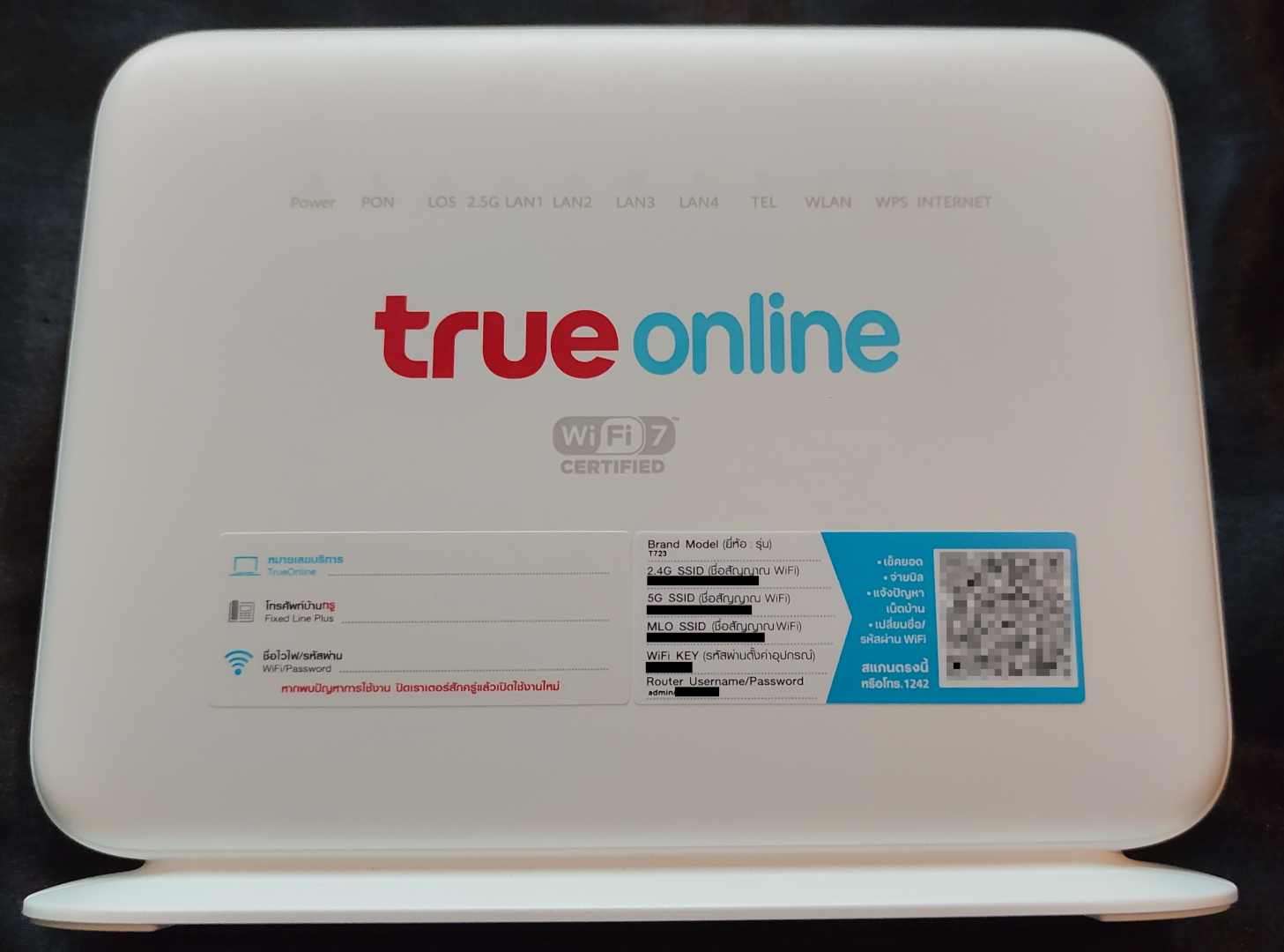
| Vendor/Brand | T3 Technology / TrueOnline |
| Model | T723 |
| CPU | 2x ARM Cortex-A9 (ARMv7 Processor rev 1) |
| Chipset | HiSilicon A9, board description HWSOC13 |
| Flash | 256 MB SPI-NAND |
| RAM | 512 MB DDR (434M exposed by the kernel boot arguments) |
| System | Huawei Dopra/WAP-derived Linux 5.10.0 |
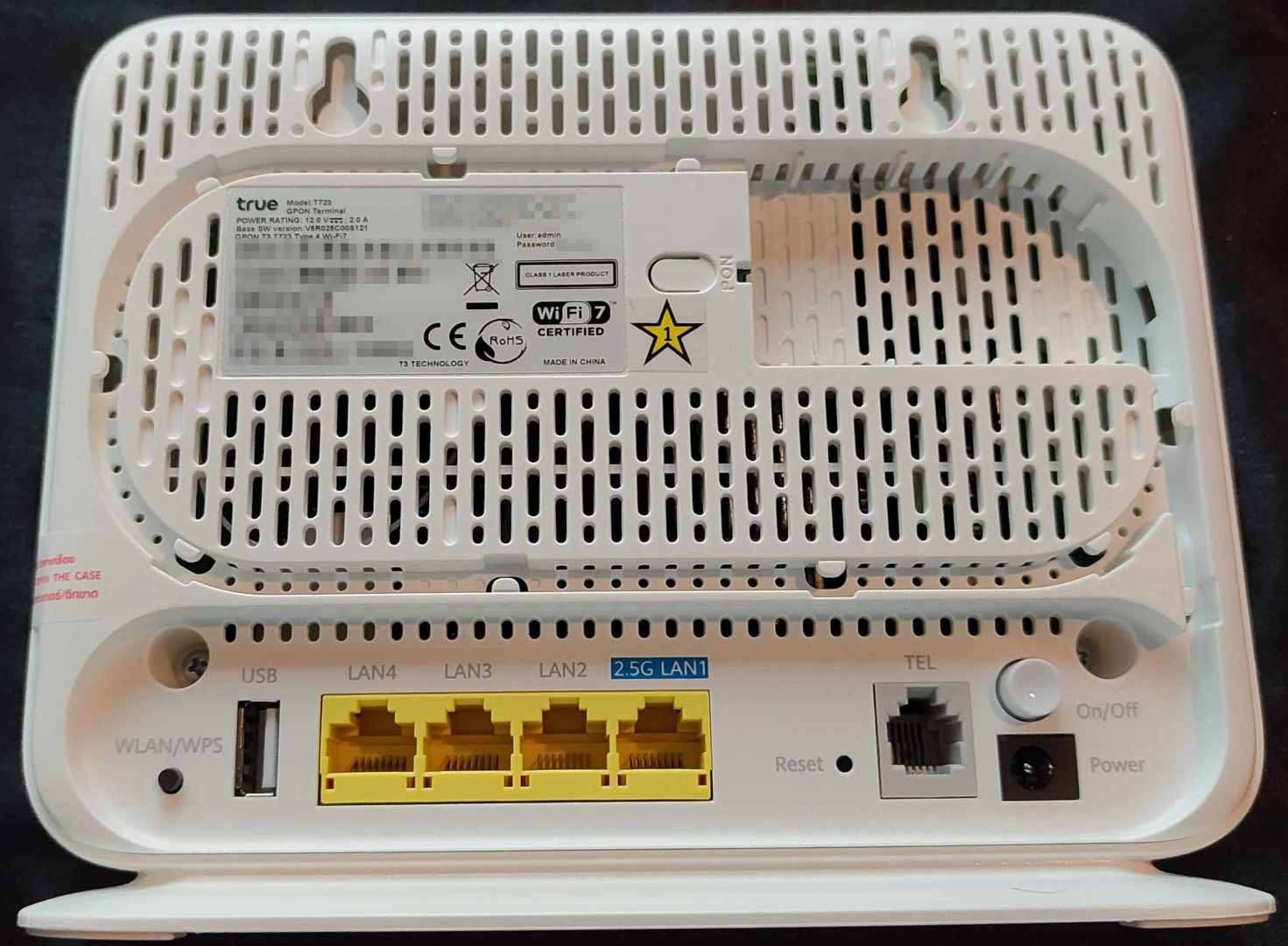
| Ethernet | 1x 2.5GbE LAN, 3x 1GbE LAN |
| Voice | 1x POTS |
| Web Gui | ✅ HTTPS |
| SSH | Disabled by default; vendor WAP CLI when enabled |
| Telnet | Disabled by default; vendor WAP CLI when enabled |
| Serial | ttyAMA1, 115200 baud in boot arguments; physical access untested |
| Form Factor | Wi-Fi 7 CPE with integrated GPON ONT |
Note
The details below were verified on a TrueOnline unit with hardware revision 4EF8.D.
Software versions
hardware version          = 4EF8.D
main software version     = V5R025C00S126
standby software version  = V5R025C00S121
uboot version             = 2022.07
kernel version            = 5.10.0
Flash layout
The boot arguments report flashsize=0x10000000, ddr_realsize=512M, flash_chip=spinand, and a SquashFS root inside ubilayer_v5.
| dev | size | erasesize | name |
|---|---|---|---|
| mtd0 | 00100000 | 00020000 | bootcode |
| mtd1 | 0ff00000 | 00020000 | ubilayer_v5 |
| mtd2 | 0001f000 | 0001f000 | flash_configA |
| mtd3 | 0001f000 | 0001f000 | flash_configB |
| mtd4 | 0001f000 | 0001f000 | slave_paramA |
| mtd5 | 0001f000 | 0001f000 | slave_paramB |
| mtd6 | 03548000 | 0001f000 | allsystemA |
| mtd7 | 03548000 | 0001f000 | allsystemB |
| mtd8 | 0001f000 | 0001f000 | wifi_paramA |
| mtd9 | 0001f000 | 0001f000 | wifi_paramB |
| mtd10 | 00117000 | 0001f000 | keyfile |
| mtd11 | 00a0d000 | 0001f000 | file_system |
| mtd12 | 07820000 | 0001f000 | app_system |
The allsystemA and allsystemB volumes provide the A/B firmware images. The tested unit booted the SquashFS image embedded in allsystemB; writable application data is stored on UBI volumes mounted below /mnt/jffs2.
Access
Vendor CLI
Both Telnet and SSH were disabled in the tested TrueOnline configuration. After they were enabled, Telnet (TCP 23) and the vendor-modified Dropbear service (TCP 22) both opened the Huawei-style WAP CLI. SSH does not provide a normal POSIX shell and may present a second Login: prompt inside the SSH session.
The tested configuration has separate privileged accounts:
superadminis theX_HW_CLIUserInfoInstanceused by the WAP CLI;telecomadminis a level-0X_HW_WebUserInfoInstanceused by the web interface.
They are not interchangeable, and their passwords are operator/device-specific.
Useful read-only commands include:
display version
display onu info
display pppoe client all
display current-configuration
display tr069 info
The su command changes the prompt from WAP> to SU_WAP>. The subsequent vendor shell command remains restricted and must not be confused with unrestricted Linux root access.
GPON status
Getting the operational status of the ONU
SU_WAP> display onu info
onuid:<redacted> reg status:O5 xpon module:1

success!
Confirming bridge mode
When the Internet WAN is bridged, the ONT has no local PPP client:
SU_WAP> display pppoe client all
----------------------------------------------------------------------
Index  Interface HW Addr             State           IP/Netmask
----------------------------------------------------------------------
----------------------------------------------------------------------
Total: 0
success!
On the tested TrueOnline service, VLAN 100 with priority 0 was retained while the WAN was changed to PPPoE_Bridged with NAT disabled. A downstream router connected to the 2.5GbE LAN1 port then established the PPPoE session. These VLAN and authentication details are operator-specific.
Configuration format
Configuration exports use two layers of Huawei encryption:
- The complete XML is gzip-compressed, encrypted with the AESCrypt2 AES-256-CBC/HMAC-SHA256 format, and prefixed by an eight-byte Huawei header. The header checksum uses polynomial
0x04C11DB7, flushing four zero bytes after every 1024-byte chunk ofIV || ciphertext || HMAC. - Sensitive XML attribute values may additionally use Huawei
$2...$strings: AES-256-CBC with an appended IV and a custom printable base-93 representation.
NetworkAndRouterTools supports the outer configuration wrapper, while huawei-utility-page documents and implements the inline $2...$ format.
Warning
Configuration exports contain device identifiers and credentials. Do not publish an original or decrypted export; use generated fixtures when testing tools.